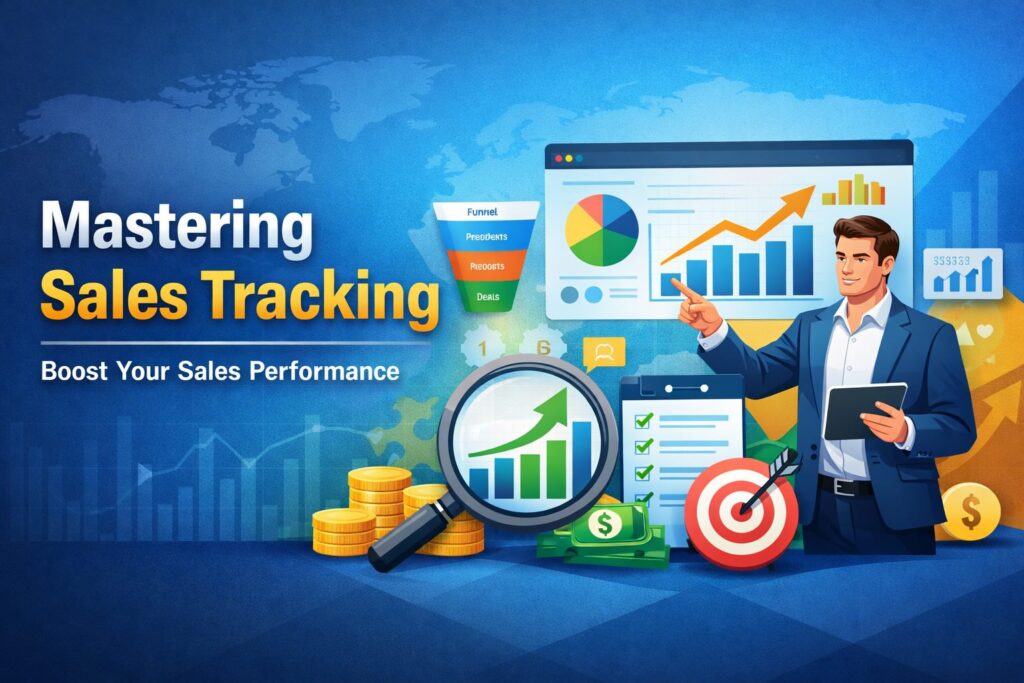
“Sales tracking” sounds simple: log activity, move deals through stages, forecast revenue, and call it a day. In reality, most organizations struggle with the same three problems – visibility, consistency, and follow-through. The result is familiar: pipeline reviews that feel like debates, forecasts that change weekly, and managers spending more time chasing updates than coaching.
This guide is designed to fix that without turning your sales process into paperwork. It explains what sales tracking software should do, how to choose it, and how to implement it so it actually gets used. You’ll also get practical examples, KPI formulas, role-based dashboards, and a rollout plan that works for both small businesses and large, distributed sales teams.
If you’re specifically evaluating sales team tracking capabilities (activity visibility, field/remote accountability, and performance monitoring), you can also review this hub page for a concrete feature set: Sales Team Tracking features.
Table of Contents
- What is sales tracking software?
- Why sales tracking breaks (even in good teams)
- What “good” sales tracking looks like in practice
- Core features checklist: what to demand from software for sales tracking
- KPIs and dashboards that actually improve outcomes
- Sales tracking management: turning tracking into a repeatable operating system
- Implementation plan (30–60–90 days)
- Sales tracking software for small business: simple, fast, and adoption-friendly
- Sales tracking software in India: practical requirements and common patterns
- Top CRM for tracking revenue targets across distributed sales teams: what matters most
- How to choose the best sales tracking software (without getting fooled by demos)
- Examples: the before/after impact of better sales tracking
- FAQs (including long-tail keyword questions)
- Key takeaways + next steps
1) What is sales tracking software?
Sales tracking software is a system that captures and organizes the data behind revenue: leads, contacts, opportunities (deals), activities (calls, emails, meetings), next steps, and outcomes then turns that activity into visibility (pipeline), insight (analytics), and accountability (targets and performance).
Some teams search for “software to track sales” or “software for sales tracking” because they’re moving away from spreadsheets. Others type “sales tracking tools” because they already have a CRM but it’s not driving behavior. And many business owners look for “sales tracking software for small business” when growth starts breaking informal processes.
In practice, sales tracking software usually sits in one of these categories:
- Sales tracking CRM: A CRM with robust pipeline, activity logging, reporting, forecasting, and workflow automation.
- Opportunity tracking software: A deal-focused system that tracks stages, probability, next step, and close dates, sometimes without deep contact management.
- Sales reporting software: Reporting-first tools that plug into your CRM/ERP to create dashboards and analytics (great for visibility, weak for daily execution).
- Sales follow up software: Task- and reminder-driven tools focused on next actions, cadences, and follow-ups (great for execution, limited for forecasting).
- Revenue tracking system: A broader approach that connects pipeline + bookings + invoicing/collections (often bridging CRM and finance).
Good sales tracking software does not just store data it reduces “sales friction.” It makes it easier to do the right thing than to do nothing: log an update, schedule the next step, move the deal forward, and keep forecasts honest.
A single source of truth for what’s in the pipeline, what’s happening next, and what revenue is likely to close.
Sales tracking vs. “activity tracking”
Some teams confuse “tracking” with pure activity volume like calls, emails, meetings. Activity is important, but activity without outcomes is noise. Great sales tracking connects activity → progression → conversion → revenue. That means you track not only how busy reps are, but whether their actions are moving deals from stage to stage.
Sales tracking is not a tool problem… until it is
Sales tracking fails most often because of inconsistent definitions (“What counts as qualified?”), weak habit formation (no one updates deals), or misaligned incentives (reps punished for honesty). But tools matter because the wrong tool makes discipline nearly impossible. When the system is slow, clunky, or demands too much manual entry, the data rots.
2) Why sales tracking breaks (even in good teams)
Most sales leaders don’t wake up and decide to run a messy pipeline. The mess is usually an emergent property of growth, complexity, and time pressure. Here are the most common breakdowns seen in business sales tracking software deployments especially in teams scaling from 3 reps to 30+.
A) “We track… but we don’t trust the data.”
The fastest way to kill adoption is to create a system where reps believe updates don’t matter or worse, will be used against them. If a rep thinks a truthful close date will trigger micromanagement, they’ll game the forecast. If a manager thinks reps are gaming the forecast, the manager stops using the tool and starts building shadow spreadsheets. That’s how “one CRM” becomes five versions of reality.
B) Over-tracking: too many fields, too many stages, too many rules
Enterprise teams often over-engineer. Small businesses often under-engineer. Over-engineering creates “form fatigue” and low-quality data (“TBD,” “NA,” “—”). Under-engineering creates ambiguity (“What does ‘proposal sent’ actually mean?”). The right answer is a minimum viable tracking model that grows with your sales motion.
C) The “pipeline meeting trap”
A pipeline review should be a coaching moment and a decision forum: where to invest time, where to escalate, where to disqualify, what to forecast. Instead, in many companies it becomes a live data-entry session: managers asking “When is this closing?” while reps scramble to update notes. When meetings are used to fix data hygiene, you lose the time you need to actually improve performance.
D) Tracking doesn’t connect to the customer journey
Buyers are more informed, less linear, and often involve multiple stakeholders. If your tracking model assumes a straight line from lead → demo → proposal → close, your pipeline will be full of “almost” deals. The solution isn’t a more complicated tool; it’s stage definitions and exit criteria that match how buyers decide.
E) Sales teams are busy – really busy
Teams are constantly fighting for selling time. If a tool adds administrative burden, adoption drops. Your tracking system must save time by reducing manual effort: automation, templates, reminders, and clean workflows.
3) What “good” sales tracking looks like in practice
In high-performing teams, sales tracking is not “extra work.” It’s the foundation that enables speed, prioritization, coaching, and predictability. Here’s what good looks like regardless of whether you’re a small business, a mid-market firm, or a Fortune 500 revenue organization.
Good sales tracking produces four outcomes
- Clarity: Everyone can answer: What’s in the pipeline? What’s the next step? Who owns it?
- Control: Leaders can intervene early on stalled deals, weak conversion points, and underperforming segments.
- Coaching: Managers coach behavior (quality activities and next steps), not just results (quota at the end of the quarter).
- Confidence: Forecasts improve because the pipeline is real, updated, and based on evidence not optimism.
Good sales tracking is role-based
One mistake is building a system that treats everyone the same. A sales rep needs a daily execution view: next actions, tasks, and priorities. A manager needs conversion, pipeline movement, and coaching signals. A head of sales needs forecasting, pipeline coverage, and performance trends. RevOps needs data quality, attribution, and process compliance.
This is where a proper sales team reporting tool becomes essential: not just “reports,” but dashboards that match decision-making responsibilities.
Good sales tracking makes it easy to follow up
Follow-up is where most deals die not because reps don’t care, but because humans are bad at sustained precision under workload. That’s why many teams also search for sales follow up software. The best sales tracking software includes follow-up discipline by default: reminders, sequences, “next step required” rules, and visibility into aging deals.
4) Core features checklist: what to demand from sales tracking software
If you’re trying to identify the best sales tracking software, start with requirements that protect adoption and data quality. Fancy features don’t matter if the basics fail.
4.1 Pipeline and opportunity tracking (the non-negotiable core)
- Customizable stages with clear stage definitions
- Opportunity tracking software views (Kanban pipeline, list view, calendar view)
- Next step + next step date as a required habit
- Deal aging and stagnation alerts
- Probability and close date fields (with guardrails)
- Deal history: stage movement, value changes, close date changes
4.2 Activity capture that doesn’t feel like data entry
- Email integration (auto-log emails or one-click logging)
- Calendar integration (meeting sync)
- Call logging and notes (manual or integrated telephony)
- Mobile app for quick updates (especially for field teams)
- Templates for call notes, discovery fields, and follow-up summaries
4.3 Sales reporting software capabilities (dashboards that drive decisions)
- Pipeline by stage, by rep, by territory, by segment
- Conversion rates (stage-to-stage and win rate)
- Sales cycle length and deal velocity
- Forecast views (committed, best case, pipeline)
- Activity vs outcomes (quality + progression indicators)
4.4 A real revenue tracking system (pipeline → bookings → revenue)
If you sell subscription, services, or anything with implementation and invoicing, you’ll eventually need a revenue tracking system that connects commercial reality to financial reality. At minimum, your sales tracking software should support:
- Product/line-item tracking (what is being sold)
- Expected start dates and billing milestones
- Integration points with finance tools (or at least clean exports)
- Revenue targets and attainment dashboards (team and individual)
4.5 Automation that protects follow-up discipline
- Workflow rules (e.g., task created when stage changes)
- Reminders for “no next step” deals
- SLAs (e.g., respond within X hours for inbound leads)
- Lead assignment and routing rules
4.6 Sales tracking management controls (so the system stays clean)
- Required fields by stage (only what’s necessary)
- Validation rules (to prevent fantasy close dates)
- Data quality monitoring (missing fields, stale deals, duplicate contacts)
- Role-based permissions (keep edits safe, preserve trust)
4.7 “Sales team tracking” for coaching and accountability
If you manage a team (especially remote or field-heavy), you need visibility into execution, not just final numbers. That’s what most people mean by sales team tracking: activity monitoring, adherence to cadence, territory coverage, and performance diagnostics.
For a feature-focused view of sales team monitoring (without fluff), see: Sales Team Tracking features.
4.8 Answering a common question directly
What sales tracking software includes activity monitoring and goal achievement analytics? The best systems do this by combining: (1) automated activity capture (email, meetings, calls), (2) goals/targets (quota, pipeline creation, meetings booked, revenue), and (3) analytics that connect activity to outcomes (conversion and velocity). If a tool only shows activity volume without connecting to progression and revenue, it’s not real goal achievement analytics.
5) KPIs and dashboards that actually improve outcomes
Many dashboards look impressive and change nothing. The goal of tracking is not “more data.” The goal is better decisions and better behavior.
5.1 The KPI stack: leading, diagnostic, and lagging indicators
Leading indicators (predict future results):
- New pipeline created (value) per week
- Qualified meetings booked
- Follow-up SLA compliance (e.g., inbound lead response time)
- Next-step coverage (percent of deals with a next step scheduled)
Diagnostic indicators (explain why results happen):
- Stage conversion rates (stage-to-stage)
- Sales cycle length by segment
- Deal aging and stagnation
- Disqualification reasons (lost/closed reasons)
- Multi-threading rate (number of stakeholders engaged)
Lagging indicators (results):
- Bookings / revenue
- Win rate (wins / total closed)
- Average deal size
- Quota attainment
5.2 Essential formulas (put these in your sales tracking software)
- Win rate = Won deals / (Won + Lost deals)
- Stage conversion = Deals entering next stage / Deals in stage
- Pipeline coverage = Pipeline value / Remaining quota
- Velocity = (Number of deals × Win rate × Avg deal size) / Sales cycle length
- Stale deal rate = Deals with no activity in X days / Total open deals
5.3 The “weekly operating dashboard” for managers
If you’re a manager, you need a dashboard that answers these five questions quickly:
- Who is behind on pipeline creation?
- Where are deals stalling (by stage and by age)?
- Is follow-up discipline slipping (next steps missing, SLAs missed)?
- Which deals need leadership help (risk, competition, approvals)?
- What should we change this week (coaching themes and process adjustments)?
5.4 The “forecast confidence” view
Forecast accuracy is not magic. It’s the product of clean definitions and honest pipeline hygiene. A useful forecast view includes:
- Commit: Deals that are genuinely expected to close (evidence-based)
- Best case: Realistic upside
- Pipeline: Everything still being worked
- Slipped deals: Deals that moved out of the period (trend matters)
- Push count: How often close dates are changed (signal of deal quality)
6) Sales tracking management: turning tracking into a repeatable operating system
Sales tracking management means building a system where tracking drives execution and coaching. It’s not just about installing a tool; it’s about creating a rhythm.
6.1 The 4 layers of a sales tracking operating system
Layer 1: Definitions (language and truth)
- What is a qualified lead? What is an opportunity?
- Stage definitions + exit criteria (what must be true to move forward)
- Close-lost reasons and how they are used (learning, not blame)
Layer 2: Workflow (daily habits)
- Every deal has a next step and date
- Every meeting has notes and a follow-up task
- Every stage change triggers a minimal checklist
Layer 3: Governance (keeping data clean)
- Stale deal rules (auto-alert after X days without activity)
- Data quality audits (missing fields, duplicates, junk stages)
- Deal review cadence (weekly manager review, monthly process review)
Layer 4: Coaching (turn insights into skill)
- Coaching themes driven by conversion points (not “try harder”)
- Call review, deal strategy, discovery quality
- Playbooks linked to stages and loss reasons
6.2 The manager’s weekly cadence (simple, repeatable)
- Daily (15 minutes): check stalled deals + urgent follow-ups
- Weekly (60–90 minutes): pipeline review focused on decisions and coaching
- Monthly (60 minutes): conversion review + process tweaks
- Quarterly: stage definitions, ICP fit, playbook updates
The trick is discipline without bureaucracy: track the minimum required to predict outcomes and coach effectively—then automate what you can.
7) Implementation plan (30–60–90 days)
Implementations fail when they treat software as the solution. Implementation succeeds when it treats software as the enabler of a better operating system. Here’s a rollout plan that works in both small and large organizations.
Days 1–30: Design for adoption
- Map your current sales process (what really happens, not what the slide deck says).
- Define 5–8 pipeline stages with exit criteria.
- Choose 8–12 essential fields (keep it lean).
- Build the “next step required” habit into the system.
- Create role-based dashboards (rep, manager, leader, RevOps).
Days 31–60: Migrate + train + enforce gently
- Data cleanup: dedupe contacts, standardize company names, fix stage history.
- Import pipeline: bring in active deals first; don’t migrate junk history.
- Train using real deals: avoid theoretical training sessions.
- Run pipeline meetings inside the tool: no shadow spreadsheets.
- Launch automation: reminders for stale deals and missing next steps.
Days 61–90: Optimize and lock in the operating rhythm
- Audit data quality weekly: missing fields, stale deals, stage misuse.
- Refine dashboards: remove vanity metrics, add decision metrics.
- Align incentives: reward honest forecasting and pipeline hygiene.
- Build playbooks: templates and checklists per stage.
- Expand integrations: email, calendar, forms, telephony, finance exports.
If you need to track and coach sales execution at the team level, anchor your rollout around a sales team tracking capability set—activity visibility, performance dashboards, and a clean workflow for updates. See: Sales Team Tracking.
8) Sales tracking software for small business: simple, fast, and adoption-friendly
Small businesses have two advantages: speed and proximity to customers. They also have two risks: informal processes and overloaded people. That’s why the best sales tracking software for small business is not the one with the most features it’s the one your team will actually use every day.
8.1 The “small business sales tracking stack” (minimum viable)
- Lead capture (forms, WhatsApp, calls, referrals)
- Simple pipeline (5–6 stages)
- Follow-up reminders (this is where sales follow up software shines)
- Basic reporting (pipeline, wins/losses, activity + next steps)
- Mobile updates (a sales tracking app for small business is often critical)
8.2 The best tools to track and increase sales in a small business (what they must enable)
When owners search “best tools to track and increase sales in a small business,” they’re usually asking for three things:
- Don’t miss follow-ups (automatic reminders, sequences, next-step enforcement).
- Know what’s going to close (pipeline clarity, deal aging, evidence-based stages).
- See what’s working (basic conversion and source performance).
8.3 How to keep tracking lightweight (the adoption rules)
- Never require more than 60 seconds to update a deal.
- Make “next step + date” mandatory.
- Use templates for notes and follow-ups.
- Automate activity capture where possible.
- Review pipeline weekly—briefly, consistently.
For small businesses with mobile or field-heavy work, choose a platform that supports quick updates and team visibility. That’s exactly the intent behind searches like “sales tracking app for small business” and “sales team software.”
9) Sales tracking software in India: practical requirements and common patterns
Searches like “sales tracking software in India,” “best sales lead tracking software in India,” and “sales tracker software in India” often come from teams with high lead volume, WhatsApp-driven conversations, and a mix of inside + field sales. The requirements tend to be practical, not fancy.
9.1 Common requirements seen in India-based sales motions
- Mobile-first execution (often the primary interface)
- Fast lead capture from multiple channels (calls, forms, marketplaces, social)
- Follow-up reliability (reminders and escalation for missed SLAs)
- Territory and route visibility for field reps (when relevant)
- Multi-currency and tax considerations for diverse customer types
- Localization (time zones, language needs, flexible custom fields)
9.2 The trap to avoid: tracking only “activity,” not “progress”
Some teams deploy a tool that logs visits and calls but doesn’t enforce next steps or stage progression. That creates busy reps and unpredictable revenue. Make sure your sales tracking software ties every activity to a deal stage, a next step, and an outcome.
10) Top CRM for tracking revenue targets across distributed sales teams: what matters most
If you manage distributed teams multiple regions, time zones, product lines, or segments the hard part isn’t tracking deals. The hard part is aligning behaviors and forecasting consistently. That’s why the query “top CRM for tracking revenue targets across distributed sales teams” is really about standardization + visibility + coaching at scale.
10.1 What distributed teams need from sales tracking software
- Standard stage definitions across teams (with allowed variations only when necessary)
- Territory/segment reporting (by region, rep, product, channel)
- Goal tracking at team and individual levels
- Forecast roll-ups (rep → manager → region → global)
- Coaching signals (deal risk, stage aging, conversion weak spots)
- Governance (data quality enforcement and auditability)
10.2 Distributed forecasting: the evidence-based approach
The best distributed teams define “commit” using evidence: stakeholder engagement, confirmed timeline, validated business case, and a next step scheduled. They also track “slip reasons” because patterns repeat: legal delays, procurement, budget freezes, champion change, or competition.
11) How to choose the best sales tracking software (without getting fooled by demos)
Demos are designed to impress. Your job is to test adoption, data quality, and decision usefulness. Use this scorecard to compare options whether you call them sales tracking tools, a sales tracking system, a revenue tracking system, or a sales tracking CRM.
11.1 The practical selection scorecard
| Category | What to test | What “good” looks like |
|---|---|---|
| Adoption | Can a rep update a deal in 60 seconds? | Fast UI, minimal required fields, mobile-friendly |
| Pipeline clarity | Are stages and exit criteria enforceable? | Stage rules + required fields by stage |
| Follow-up discipline | Does it prevent “no next step” deals? | Next step required + reminders + automation |
| Reporting | Can managers diagnose conversion problems quickly? | Stage conversion, velocity, aging, cohorts |
| Forecasting | Can leaders separate commit vs best case reliably? | Forecast categories + evidence fields + roll-ups |
| Data hygiene | How does it handle duplicates, missing data, stale deals? | Quality monitoring + governance tools |
| Integrations | Email, calendar, forms, telephony, finance exports | Low-friction integrations or strong APIs |
| Scale | Roles, permissions, territories, multi-team reporting | Enterprise controls without complexity overload |
11.2 “Best sales rep tracking software” is really an adoption question
Teams often search for “best sales rep tracking software” when managers can’t see what’s happening: Are reps following up? Are they progressing deals? Are they stuck? The right tool creates visibility without turning reps into data-entry clerks. Look for automation, activity capture, and dashboards that highlight risk and next actions.
11.3 “Best revenue tracking tool” is about connecting sales to outcomes
If you’re searching for “best revenue tracking tool,” you want to connect: pipeline → forecast → bookings → revenue recognition (or at least invoicing/collections). Your sales tracking software doesn’t have to do everything, but it must support clean exports, integrations, and accurate definitions.
11.4 A note on “best software solutions for tracking sales performance and customer behavior?”
This question usually mixes two needs: (1) sales performance tracking software for pipeline and rep performance, and (2) customer behavior analytics (product usage, web engagement, marketing attribution). The winning approach is often integration: keep sales execution in the CRM/sales tracking tool, and bring customer behavior signals in via integrations so reps can prioritize and personalize.
12) Examples: the before/after impact of better sales tracking
Example 1: The “invisible pipeline” small business
Before: Deals in spreadsheets, follow-ups in memory, forecast is gut-feel. Owner asks, “What’s closing this month?” and gets different answers each time.
After: A simple sales tracking software setup with: 6 stages, required next steps, automated reminders, and a weekly pipeline dashboard. Within weeks, follow-ups increase, stale deals are identified early, and forecasting becomes calmer. This is why many teams adopt a sales tracking system even before they think they’re “big enough.”
Example 2: The scaling team with missed handoffs
Before: Leads are captured, but qualification is inconsistent. Reps chase low-fit deals, while good opportunities stall because the next step isn’t scheduled.
After: The team enforces stage exit criteria and required fields at qualification. Managers track stage conversion and deal aging weekly. Marketing and sales align on what counts as qualified. Pipeline quality improves and so does win rate.
Example 3: Distributed teams with unreliable forecasts
Before: Each region uses different stage definitions and forecasting assumptions. Roll-ups are inconsistent and quarter-end is chaotic.
After: Standard definitions + evidence-based commit criteria. A global dashboard shows slip reasons, stage aging, and pipeline coverage by region. The organization finally has a predictable, coachable revenue engine.
13) FAQs
What is the best sales tracking software?
The “best sales tracking software” is the one your team adopts and keeps clean. Look for fast deal updates, automation, strong reporting, and follow-up enforcement. A tool with perfect features but poor adoption will lose to a simpler tool that reps actually use.
What is the best sales tracking software for small business?
The best sales tracking software for small business is easy to set up, simple to use daily, and strong on reminders and pipeline visibility. Prioritize mobile access, next-step discipline, and clean dashboards.
What features are essential in sales tracking software for small business?
- Pipeline stages + deal aging
- Next step + reminders
- Basic reporting (pipeline, wins/losses, activity)
- Lead capture and assignment
- Mobile support (sales tracking app for small business)
What is a sales tracking CRM?
A sales tracking CRM is a CRM designed to manage the full sales process: contacts, leads, deals, activities, follow-ups, reporting, and forecasting. It’s the most common “home” for sales tracking because it combines execution and visibility.
What is sales tracking management?
Sales tracking management is the leadership discipline of turning tracking into an operating rhythm: definitions, workflows, governance, dashboards, and coaching. It ensures tracking improves outcomes rather than creating admin work.
What sales tracking software includes activity monitoring and goal achievement analytics?
Look for systems that automatically capture activities (email/meetings/calls), support targets (quota, pipeline creation, meetings), and link activity to outcomes (stage progression, conversion, revenue). If a tool only measures volume, it won’t provide meaningful goal achievement analytics.
How do I compare different platforms for closing ratios?
Compare tools based on how they calculate and display win rate (closing ratio): Do they track stage-to-stage conversion? Can you segment by rep, region, product, lead source? Do they handle “no decision” outcomes correctly? The best tools show trends over time and connect win rate to deal quality and cycle length.
How do I choose the most accurate closing ratio tracking system?
Accuracy comes from definitions and hygiene: consistent stage definitions, honest close-lost reasons, and clean deal records. Choose a system that enforces required fields and flags stale or incomplete opportunities.
What alternatives exist to track deals in the pipeline?
Alternatives range from spreadsheets (high effort, low reliability) to CRM-based pipeline tracking (best for scalability). Many teams start with a simple pipeline board, then graduate to a full sales tracking CRM with automation and reporting.
Is there a sales tracking simulator or demo environment? (sales tracking simulator)
Many vendors offer sandboxes or demo accounts. A “sales tracking simulator” is useful when you want to test: speed of updates, workflow automation, and reporting using real scenarios without disrupting live data.
14) Key takeaways + next steps
- Sales tracking software should reduce friction, not add admin work.
- Adoption beats complexity. Keep fields lean and workflows fast.
- Track progression and outcomes not just activity volume.
- Make “next step + date” a non-negotiable habit.
- Use dashboards for decisions and coaching, not vanity metrics.
If your priority is improving visibility and accountability across reps (especially remote/field), start by reviewing the concrete feature set here: Sales Team Tracking. It’s a natural hub for teams evaluating sales tracking software with team monitoring and reporting in mind.
References (data sources mentioned in this guide)
- Salesforce (2024): Sellers report time spent on non-selling tasks; State of Sales insights.
https://www.salesforce.com/news/stories/sales-ai-statistics-2024/ - Gartner (2020): 45% of sales leaders and sellers have high confidence in forecasting accuracy.
https://www.gartner.com/en/newsroom/press-releases/2020-02-12-gartner-says-less-than-50–of-sales-leaders-and-selle - Nucleus Research (2014): CRM pays back $8.71 for every dollar spent (based on analyzed ROI case studies).
https://nucleusresearch.com/research/single/crm-pays-back-8-71-for-every-dollar-spent/ - HubSpot (2025): Sales reps dedicate only two hours daily to active selling; admin takes about an hour; sales benchmarks.
https://blog.hubspot.com/sales/sales-statistics - monday.com (2025): Sales tracking software overview, features, and pricing discussion (varies by plan and use case).
https://monday.com/blog/crm-and-sales/sales-tracking-software/