Run CRM workflows from the exact events your team already manages.
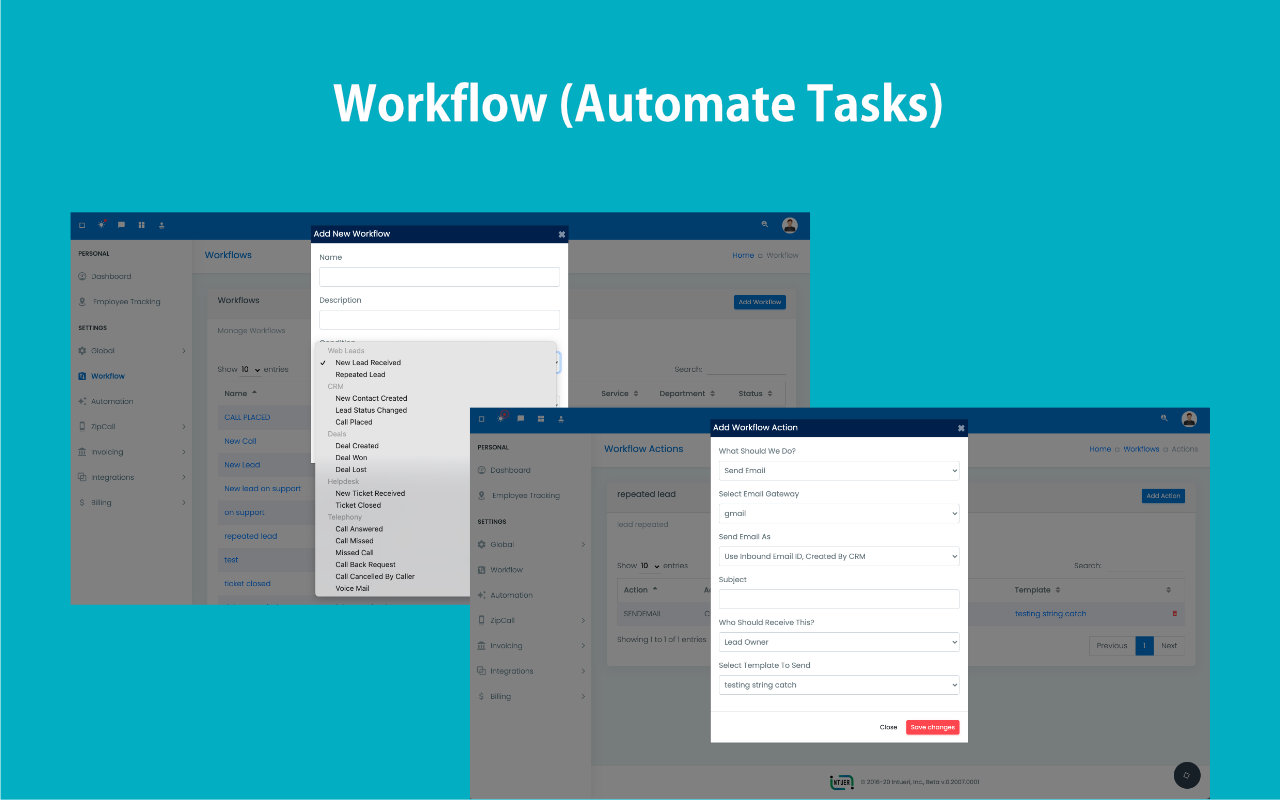
Configure workflow rules around triggers like new leads, lead status changes, deal wins or losses, tickets, telephony, or payment events, then launch the right action sequence without manual follow-up.
- Start automation from real CRM moments such as lead creation, status changes, and deal updates.
- Save the rule first, then configure one or more actions on the dedicated workflow actions screen.
- Use templates, gateways, departments, and webhooks as reusable building blocks behind every rule.
Automation that keeps response quality high as volume grows.
Designed to make routing, messaging, and event handling feel immediate and reliable.
Trigger first-touch actions before leads wait in unattended queues.
Apply the same routing and messaging every single time.
Move records to the right team without confusion.
Push webhook events when external systems need updates.
Grow volume without growing repetitive admin effort.
Workflows turn scattered tasks into one controlled sequence.
Manual follow-up breaks the customer experience.
When actions depend on memory, speed drops, ownership gets blurry, and records stop reflecting what actually happened.
Slow first responses
New leads wait in a queue while someone checks mail, assigns ownership, and sends the same message again.
Inconsistent execution
Different team members add different tags, trigger different templates, and skip the same internal updates.
Disconnected systems
Important CRM events never reach external tools until somebody exports data or pushes it manually.
Build workflow logic around the same templates, gateways, and departments your CRM already uses.
Each rule combines a trigger, matching conditions, and a separate actions layer, so the automation fits the live operating model instead of becoming a parallel system.
Operational triggers
Start automations from new lead events, lead status changes, deal outcomes, tickets, telephony, or payments.
Condition matching
Branch by team, source, product, lead status, department, or user ownership before firing the action chain.
Dependency aware
Use existing email templates, SMS gateways, webhooks, departments, and users instead of recreating assets inside each workflow.
Separate action setup
After the rule is saved, the next screen lets you stack the exact actions that should run in sequence.
Automation blocks your team will actually use.
The action library mirrors real CRM operations instead of generic automation blocks.
Outbound messaging
Trigger Send Email, Send SMS, Send Whatsapp Message, or Send Mobile Push Notification from the same rule.
Internal routing
Use In-CRM Notification, Slack Notification, or Transfer Lead To Department to coordinate teams immediately.
Record updates
Add Tag and Remove Tag actions keep segmentation and downstream reporting consistent.
External execution
Execute Webhook when another tool should react to the same CRM event in parallel.
Fewer missed steps. Faster responses. Better dependency-driven automation.
Because workflows reuse configured templates, gateways, statuses, and departments, they stay practical for real teams instead of becoming isolated automation experiments.
- Respond to new leads instantly with the right message, transfer, or tag update.
- Keep deal-won, deal-lost, telephony, ticket, and payment follow-ups standardized.
- Centralize action logic while still using existing templates and gateway settings.
- Connect CRM activity to other systems with Execute Webhook when needed.
First-touch actions happen immediately after the trigger is recorded.
Tags, templates, and routing stay consistent across the team.
Managers can review the workflow logic instead of chasing one-off explanations.
As lead volume grows, process quality does not depend on memory.
Create the rule, save it, then attach the action stack.
The actual workflow setup follows the product flow in the admin: rule first, actions second.
Open workflow setup
Open the workflow builder and create the rule that should respond to a CRM event.
Choose trigger and conditions
Select events like new lead or lead status changed, then define the matching fields and dependencies.
Save and add actions
After saving the rule, configure Send Email, SMS, WhatsApp, notifications, transfer, tags, or webhook actions.
Refine live dependencies
Update templates, gateways, statuses, departments, or webhook endpoints as your process evolves.
See how the automation layer fits into daily work.
Use workflow triggers for immediate outreach, internal coordination, and smooth handoffs between teams and tools.
From admin rule setup to action execution in one controlled flow.
Show how the CRM converts trigger events into messaging, routing, tagging, and webhook delivery.
Built for teams that need process reliability at scale.
When follow-up speed matters, automation becomes part of the service experience, not just an internal shortcut.
"We can route, respond, and tag instantly now, which means the team spends less time coordinating and more time actually selling."
"The biggest win is not just speed. It is knowing every lead gets the same first-touch process without depending on who saw it first."
Put repetitive CRM actions on autopilot.
Launch faster lead responses, cleaner internal routing, and dependable follow-up logic from one workflow layer inside ZNICRM.